


I Ching Explorer


-
☯I Ching Basics
-
☯Consulting I Ching
-
☯Chinese Zodiac
-
☯I Ching Resources
-
If you like our web site and find it useful - donate with PayPal to support new development
The I Ching Diet: A Structural Approach to Nutrition
The I Ching Diet is an innovative, experimental dietary approach first introduced here at IChing360.com and further explored at FoodGalaxies.com. As a "first cousin" to the Macrobiotic Diet, it utilizes the fundamental Yin-Yang balance but introduces a revolutionary focus: the vertical layered structure of food.We study how the binary combination of Yin (moist/cool) and Yang (dense/warm) components creates a "gastronomic code" that affects taste, nutrition, and digestion.
In I Ching Diet theory, meals are designed in three complementary structural forms:
- The Double Trigram (Binary Stack): A 6-layered representation where two 3-layer "Trigrams" combine to form a full hexagram. Ideal for structured drinks and soups.
- The Triad (The Human Scale): A 3-layer structure representing Earth (Foundation), Humanity (The Heart), and Heaven (The Finish).
- The Full Hexagram: Six distinct components layered vertically. This is the ultimate expression of the I Ching in food—perfect for the architecture of tortes, sandwiches, and multi-layered main courses.
1. The 8 Culinary Trigrams
This approach is based on 8 Culinary Trigrams which, when combined in pairs, create 64 base food forms.Below is the framework categorizing ingredients by their elemental nature and Yin/Yang balance:
| Trigram | Nature | Taste | Ingredient Profiles |
|---|---|---|---|
| ☰ Heaven | Creative (111) | Pungent | Dense, dry, high-protein: Seared steak, crusty baguette. |
| ☷ Earth | Receptive (000) | Bland-Sweet | Soft, moist, grounded: Mashed potatoes, steamed greens. |
| ☲ Fire | Clinging (101) | Bitter | Sharp/Bright: Chili peppers, sharp cheddar. |
| ☵ Water | Abysmal (010) | Salty | Fluid/Deep: Smoked salmon, balsamic glaze. |
| ☳ Thunder | Arousing (001) | Sharp Sour | Kinetic: Radishes, sprouts, crackling elements. |
| ☴ Wind | Gentle (110) | Aromatic Sour | Light/Pervasive: Basil, cilantro, thin prosciutto. |
| ☶ Mountain | Keeping Still (100) | Astringent | Heavy/Foundational: Thick-cut roasted root veg. |
| ☱ Lake | Joyous (011) | Joyous Sweet | Yielding/Pleasant: Fruit reductions, honey, avocado. |
Example: The "Nourishing" Sandwich - Hexagram 27 (頤 - Yi):
Hexagram 27, "The Corners of the Mouth," visually represents an open mouth (100001). We build it from the bottom up:- Bottom Trigram (Thunder ☳): Toasted Sourdough (Yang), Sprouts (Yin), Shredded Cabbage (Yin).
- Top Trigram (Mountain ☶): Sliced Avocado (Yin), Heirloom Tomato (Yin), Thick-cut Smoked Turkey (Yang).
2. Three-Layered Food: The Triad Structure
Many recipes follow a natural 3-layer form—such as a soup with a roasted base, a savory broth, and a garnish. In I Ching theory, this follows the Culinary Digram Index:| Symbol | Name | Nature | Layering Logic (Bottom to Top) |
|---|---|---|---|
| ⚌ | Old Yang | Solid Heat | Two dense, dry, or hot layers (1-1). |
| ⚏ | Old Yin | Pure Fluid | Two soft, moist, or cooling layers (0-0). |
| ⚍ | Young Yang | Rising Energy | Yang Base (1) with a Yin Top (0). |
| ⚎ | Young Yin | Descending | Yin Base (0) with a Yang Top (1). |
3. Six-Layer Food: The Vertical Data Stack
In this model, the meal becomes a Vertical Data Stack. We categorize ingredients by their "Binary Bit":- 1 (Yang —): Heat-inducing, dry, hard, or dense (e.g., Red meat, toasted bread).
- 0 (Yin - -): Cooling, moist, soft, or expansive (e.g., Cucumber, tomato, mayo).
Example: The "Inner Peace" Torte (Hexagram 11 (泰 - Tai / Peace)
Structure: 000111 (Earth over Heaven)- Line 6 (Top): Whipped Cream or Light Mousse (0)
- Line 5: Fresh Strawberry or Peach slices (0)
- Line 4: Soft Vanilla Sponge (0)
- Line 3: Dense Almond Cake layer (1)
- Line 2: Dark Chocolate Ganache (1)
- Line 1 (Bottom): Shortbread Crust (1)
4. The Culinary Binary Index: Energetic Bit-Mapping for the I Ching Diet
To build a dish, you must first identify the energetic "Bit" of each component.A brief excerpt from culinary binary index is shown below.
This index serves as a foundational guide; the binary logic can be extended to any ingredient based on its thermal and structural properties.
| Yin Food (0) | Yang Food (1) | Neutral Food |
|---|---|---|
| Almonds | Beef | Bread |
| Apple | Black pepper | Carrots |
| Asparagus | Brown sugar | Cauliflower |
| Bamboo | Butter | Cherries |
| Banana | Cheese | Lean chicken meat |
| Barley | Chicken (liver/fat) | Dates |
| Bean curd | Chili Peppers | Figs |
| Bean sprouts | Chocolate | Milk |
| Beer | Coffee | Olives |
| Broccoli | Eggs | Peaches |
| Cabbage | Fish (smoked) | Peas |
| Celery | Garlic | Pigeon |
| Clams | Green peppers | Plums |
| Corn | Goose | Pork (Raw) |
| Corn flour | Ham | Raisins |
| Crab | Kidney beans | Brown rice |
| Cucumber | Lamb | Steamed white rice |
| Duck | Leeks | Sweet Potato |
5. The Tri-Hexagram Food Model: Multi-Layer Interpretation of Culinary Structures
The Culinary Binary Index demonstrates how each I Ching hexagram can be translated
into a layered culinary structure using the language of Yin-Yang polarity.
In this approach, each line of the hexagram corresponds to a physical ingredient layer within a dish,
allowing recipes to mirror the binary architecture of the I Ching itself.
As practical recipe experiments accumulated, it became clear that the binary structure of
layered dishes sometimes expressed additional energetic patterns beyond the primary hexagram used for their design.
Ingredients possess not only Yin-Yang polarity but also thermal properties and traditional organ associations recognized
in Chinese dietary philosophy. When these qualities were examined together, they occasionally formed coherent secondary hexagram patterns.
This observation suggested that layered recipes might simultaneously reflect several symbolic structures within the I Ching system.
This in turn led to the formulation of what may be called the Tri-Hexagram Food Model.
In this model, a dish may be interpreted simultaneously through three complementary hexagram perspectives.
The Tri-Hexagram interpretation relies on predefined ingredient classifications drawn from traditional food energetics.
The first one is the Structural Hexagram. This is the primary hexagram used to design the recipe itself
and serves as a polarities index. Its six Yin-Yang lines determine the sequential number, order, and polarity of the ingredient layers.
The Structural Hexagram therefore defines the visible vertical architecture of the dish.
The second one is the Thermal Hexagram. Traditional food cultures - including Chinese dietary philosophy -
recognize that foods possess energetic qualities such as warming, cooling, moistening, or drying. When ingredients are arranged in a layered recipe,
these thermal characteristics may themselves form a symbolic Yin-Yang pattern that corresponds to another hexagram structure.
The third is the Resonant Organ Hexagram. Certain foods are historically associated with particular organs,
elements, or trigram correspondences within Traditional Chinese Medicine (TCM). When these associations are mapped onto the layers of a dish,
they may produce yet another hexagram pattern that symbolically resonates with the body’s internal energetic systems.
Taken together, these three perspectives form a triangular interpretive STR-framework:
- Structural Hexagram – the physical architecture of the recipe
- Thermal Hexagram – the energetic temperature profile of ingredients
- Resonant Organ Hexagram – the organ or elemental correspondences of the food
This tri-layered interpretation does not replace the original hexagram-recipe mapping introduced earlier in the I Ching Diet.
Instead, it expands the framework by revealing that a single dish can participate in multiple symbolic relationships within the I Ching system.
In more scientific terms, the Structural Hexagram may be compared to a hardware configuration,
while the Thermal and Resonant Organ hexagrams function more like software layers operating on that structure.
In practical terms, this means that a recipe inspired by one hexagram may also reveal
meaningful relationships with other hexagrams when viewed through thermal or resonance patterns.
The result is a richer symbolic landscape in which culinary structures reflect multiple dimensions of the I Ching cosmology.
The Tri-Hexagram Food Model should therefore be understood as an additional interpretive layer within the I Ching Diet framework -
one that highlights the remarkable capacity of hexagram symbolism to extend beyond divination and philosophy into the creative domain of food design.
5.1. Completing the "Thermal Hexagram" Binary
To make the Thermal Hexagram (T) as mathematically consistent as the Resonant Organs (R) and Structural (S) culinary hexagrams, we need a binary "Cut-Off" point for temperature. In TCM, thermal nature is usually a 5-point scale (Cold, Cool, Neutral, Warm, Hot). To turn this into a Binary Bit, we apply the "Expansion/Contraction" rule:| Binary Bit | Thermal Quality | Energetic Direction | Examples |
|---|---|---|---|
| 0 Yin |
Cold / Cool / Moist | Contracting / Sinking | Cucumber, Seaweed, Raw Greens, Water. |
| 1 Yang |
Warm / Hot / Dry | Expanding / Rising | Ginger, Toasted Grains, Seared Meat, Pepper. |
The "Neutral" Rule: In a binary system, "Neutral" ingredients (like Rice or Carrots) act as Contextual Carriers.
They usually take the bit of the Structural Layer they occupy, or can be toggled by the cooking method (e.g., raw carrot = 0, roasted carrot = 1).
5.2. The Organ-to-Binary Conversion Table
In Traditional Chinese Medicine (TCM), organs are already naturally paired into Zang (Yin / Solid / Storing) and Fu (Yang / Hollow / Transmitting). By using this ancient division as our binary anchor, we ensure the system is self-sufficient and aligns with traditional logic.This table defines the "Resonance Bit" for any ingredient based on its target organ.
| Binary Bit | TCM Category | Function | Included Organs |
|---|---|---|---|
| 0 (Yin) | Zang Organs | Storing Essence, Solid, Internal | Heart, Liver, Spleen, Lungs, Kidneys |
| 1 (Yang) | Fu Organs | Transmitting/Digesting, Hollow, Active | Small Intestine, Gallbladder, Stomach, Large Intestine, Bladder |
Food Architect’s Note:
If an ingredient targets multiple organs (e.g., Spleen and Stomach),
the bit is determined by the Primary Intent of the layer or the Dominant Action (e.g., if the goal is to move food, it is a 1; if the goal is to nourish blood, it is a 0).
To better illustrate these new concepts let’s have a closer look at the following example.
5.3. Hexagram #1 “Pure Energy” Sandwich
To illustrate the Tri-Hexagram Food Model, let’s build a sandwich food recipe
based on Hexagram #1, often associated with pure creative force.
This recipe has 6 Yang layers and follows the 1-1-1-1-1-1 structural binary footprint.
When it comes to the recipe, any six ingredients classified as Yang can form the structure of our sandwich.
Let’s use six familiar Yang ingredients below:
- Layer 1. Base: 1 slice of Sourdough Baguette (toasted),
- Layer 2. Spicy Dijon Mustard,
- Layer 3. Two cloves Garlic (thinly sliced and sautéed until golden),
- Layer 4. Protein: 4oz Grass-fed Sirloin (seared and thinly sliced),
- Layer 5. Aged Parmesan Cheese,
- Layer 6. Top: 1 slice of Sourdough Baguette (toasted),
Each ingredient expresses Yang polarity within the structural framework. However, when thermal qualities and organ associations are applied, additional patterns emerge.
Once the recipe ingredients are defined we can use TCM (Traditional Chinese Medicine) to bridge them
into two additional dimensions mentioned above – TCM Quality and Target Body Organ.
-
Layer 6 (Top) [1] – Toasted Sourdough (Cap):
- I Ching Polarity: 1
- TCM Quality: Warm / Sour / Crunchy.
- Target Organ: Enters the Gallbladder and Stomach.
- Organ Bit: 0 (Zang)
-
Layer 5 [1] – Aged Parmesan & Black Pepper:
- I Ching Polarity: 1
- TCM Quality: Warm / Salty / Pungent.
- Target Organ: Enters the Kidneys.
- Organ Bit: 1 (Fu)
-
Layer 4 [1] – Grass-fed Sirloin:
- I Ching Polarity: 1
- TCM Quality: Warm / Sweet.
- Target Organ: Enters the Spleen (to nourish Blood).
- Organ Bit: 1 (Fu)
-
Layer 3 [1] – Sautéed Garlic:
- I Ching Polarity: 1
- TCM Quality: Hot / Pungent.
- Target Organ: Enters the Spleen (to resolve stagnation).
- Organ Bit: 1 (Fu)
-
Layer 2 [1] – Spicy Dijon / Chili Oil:
- I Ching Polarity: 1
- TCM Quality: Hot / Sharp / Pungent.
- Target Organ: Enters the Lungs.
- Organ Bit: 0 (Zang)
-
Layer 1 (Base) [1] – Toasted Sourdough (Foundation):
- I Ching Polarity: 1
- TCM Quality: Warm / Sour / Crunchy.
- Target Organ: Enters the Spleen.
- Organ Bit: 0 (Zang)
This food recipe example, makes it clear that in I Ching Diet world every traditional I Ching Hexagram produces one primary recipe hexagram with (at least) two related / shadow / phantom hexagrams from the culinary world.
Hexagrams classify energetic architecture, while ingredient sequencing shapes the lived culinary experience.
So, each I Ching hexagram becomes a recipes design framework, not a rigid formula. And our mouth acts as an integration chamber for 6 layers of I Ching Food.
5.4. Systemic Analysis: The #1 "Pure Energy" Sandwich
Bringing all above outlined facts, we can now finalize the STR-footprint for our sandwich. This reveals a hidden "Phantom" signature that the body actually processes:| Layer | Ingredient | Structural (S) | Thermal (T) | Resonance (R) |
|---|---|---|---|---|
| 6 | Toasted Sourdough | 1 | 1 (Warm) | 0 (Zang) |
| 5 | Parmesan/Pepper | 1 | 1 (Warm/Hot) | 1 (Fu) |
| 4 | Sirloin | 1 | 1 (Warm) | 1 (Fu) |
| 3 | Sautéed Garlic | 1 | 1 (Hot) | 1 (Fu) |
| 2 | Dijon/Chili Oil | 1 | 1 (Hot) | 0 (Zang) |
| 1 | Toasted Sourdough | 1 | 1 (Warm) | 0 (Zang) |
| HEX | RESULT | #1 (Creative) | #1 (Creative) | #31 (Influence) |
In this example, the resulting Resonant Organ Hexagram forms the binary sequence: 011100 (Layer 6 ➔ Layer 1)
which maps to Hexagram #31 - Influence (咸 - Xián) – Lake ☱ over Mountain ☶
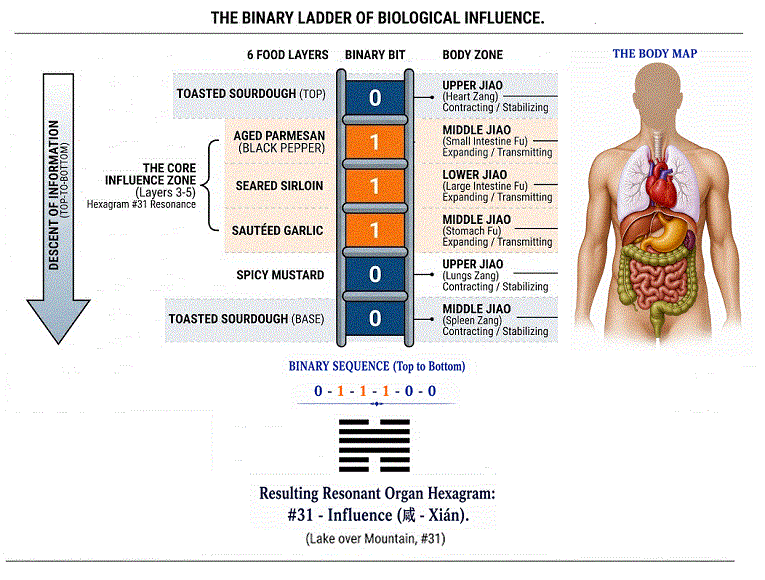
Food Recipe Architect’s Notes. Hexagram #31 (Influence) resonates with the “Pure Energy” sandwich by demonstrating how distinct, powerful ingredients
- Dijon, Sirloin, and Parmesan - can exert a reciprocal effect on one another. The sandwich is not just a collection of layers, but a system of mutual attraction
where the warmth of the beef “influences” the pungency of the mustard, creating a unified and dynamic metabolic response.
This may open an interesting direction for further exploration within the I Ching Diet framework.
5.5. What is Next?
What are the other important areas of I Ching Diet left out of the scope of this page? Below are some of the exciting I Ching Diet areas we work on now. These deep structural questions form the core research for the upcoming volume: The I Ching Diet.5.6. Satellite Recipes
By specifying Yin-Yang lines polarities each hexagram lays out the flexible recipe template.
Once the template guardrails are in place, the next step for any recipe designer would be
direct mapping of physical food ingredients to Yin-Yang layout in that template.
As both Yin and Yang clusters are represented by variety of “competing” food ingredients,
each I Ching Hexagram template opens the door wide open for variety of related to that
template individual food recipes. They could be recipes from the same category, for example –
Appetizers, or from other food categories – Soups, Desserts, Drinks or main Courses.
More detailed examples of Hexagram #1 related satellite recipes can be found here:
The Principle of Moving Polarity.
In the I Ching, lines are not always static; they can be "Moving Lines" that represent a state of transition from Yin to Yang or vice versa. In the culinary world, this is mirrored by Neutral Ingredients. These are components - such as rice, potatoes, or certain mild proteins - that do not possess a dominant polarity on their own. Instead, they act as "energetic sponges", adopting the binary bit of the ingredients they are paired with or the cooking method applied to them. This adds a dynamic layer to recipe design. A "Moving Yin" ingredient might begin as a soft, moist component [0] but, through the application of intense heat or pungent spices, "flips" to provide a Yang [1] effect in the finished dish. Understanding these transitions allows the practitioner to move beyond rigid recipes and create meals that capture the I Ching’s core philosophy: the constant, rhythmic flow of change.Culinary Hexagram Transformations.
Classic I Ching Hexagrams enjoy the powerful families of hexagram transformations that highlight and expose the primary hexagram structure. Most popular of them is a so-called Nuclear Hexagram made of combination of [2, 3, 4] and [3, 4, 5] lines of primary hexagram. In classic I Ching, these Nuclear Hexagrams emphasize an internal creative and birth-giving kernel of hexagram. How this concept applies to I Ching Diet? Should we apply nuclear transformation to primary hexagram directly or to its Thermal or Resonant counterparts? We don’t have final answers for it now. These deep structural questions - such as the role of Nuclear Hexagrams in digestion - form the core research for the upcoming dedicated volume: The I Ching Diet. Happy I Ching Dieting for you and Your Close Ones! The Tri-Hexagram Food Model is an early exploration of how culinary design, traditional food energetics, and the symbolic language of the I Ching may intersect. Further developments of this framework will be presented in the forthcoming volume The I Ching Diet.Ready to apply the Gastronomic Code to your kitchen? Visit FoodGalaxies.com to discover the full Appetizer series for the Foundational Hexagrams and explore how we turn these binary structures into gourmet reality.